
LUCAS is a portable machine that performs chest compressions on a person whose heart has stopped. It replaces the pushing that a rescuer would otherwise do by hand.
The short version
When a heart stops pumping, blood stops moving. Chest compressions squeeze the heart between the breastbone and the spine, pushing a little blood around the body until the heart can be restarted or a cause can be treated. Doing this well by hand is exhausting. Rescuers tire within minutes, compressions get shallower and slower, and there are moments when compressions have to stop, for instance while carrying a patient down a staircase.[1]
LUCAS was built to remove that problem. It clamps around the chest and presses a piston with a suction cup on the lower half of the breastbone, around a hundred times a minute, at the same depth every time, for as long as its battery lasts. The name stands for Lund University Cardiopulmonary Assist System, after the Swedish university hospital where it was developed.[2]
At a glance
- What it does: automatic chest compressions during cardiac arrest.
- What it does not do: deliver electric shocks, give breaths, or diagnose anything.
- Who makes it: Jolife AB in Lund, Sweden, now part of Stryker.[3]
- Who uses it: ambulance services, emergency departments, cardiac catheterisation labs and intensive care units.
- Current model: LUCAS 3, version 3.1, battery powered, about 7.8 kg with battery.[4]
- Does it save more lives than manual CPR? Large trials say survival is about the same. See Clinical evidence.
The parts of the device
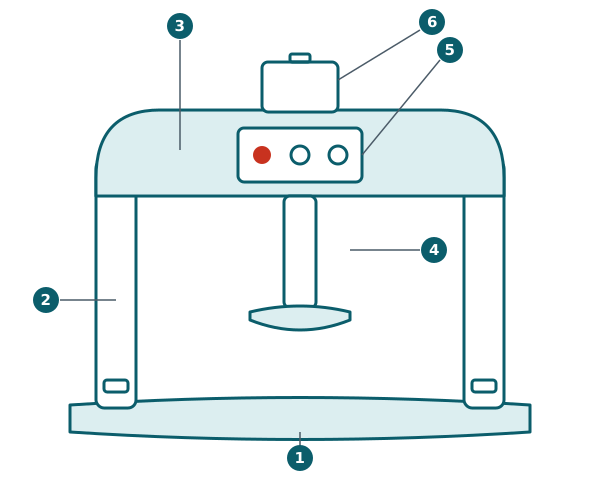
- Back plate. A thin, stiff board that slides under the patient’s shoulders. It gives the piston something firm to push against, so the force goes into the chest rather than into a soft mattress or the ground.
- Support legs. Two arms that click onto the sides of the back plate and hold the upper part in place. They lock with a claw at each end.
- Upper part. The bridge across the chest. It houses the motor and electronics that drive the piston.
- Piston and suction cup. The moving part. The rescuer lowers it until the cup touches the lower half of the breastbone. The cup is soft, disposable and helps the chest return to its starting height after each push.
- Control panel. A handful of buttons: power, adjust, and two compression modes, continuous or 30 compressions followed by a pause for two breaths. Lights and beeps warn about low battery or a fault.
- Battery. A rechargeable lithium-ion polymer pack that gives about 45 minutes of use, or longer when the device is plugged into a wall or vehicle socket.[4]
Where you will see it
Ambulance services were the first big users, because a moving vehicle is one of the hardest places to do good manual CPR. Hospitals use it in emergency departments, on wards, and in the cardiac catheterisation lab, where a cardiologist may need to open a blocked artery while compressions carry on. It also turns up in helicopter rescue, in hospitals that cool patients after prolonged arrest, and in centres that put patients on a heart-lung machine during resuscitation, a technique called extracorporeal CPR.[5]
What it is not
It is not a defibrillator. A defibrillator delivers an electric shock to reset a chaotic heart rhythm; LUCAS does not. The two are often used together, and one selling point of the device is that a shock can be given while compressions continue.[6]
It is not a substitute for a trained team. Someone still has to manage the airway, give drugs, decide when to shock and when to stop. Guidelines are clear that the device should be used by teams trained on it, and that fitting it must not interrupt compressions for long.[7]
It is not for children. The device only fits an adult-sized chest: the breastbone has to sit between roughly 17 and 30 cm above the back plate, and the chest can be no wider than about 45 cm.[4]
Keep reading
Sources
- Wang PL, Brooks SC. Mechanical versus manual chest compressions for cardiac arrest. Cochrane Database of Systematic Reviews. 2018;8:CD007260. doi:10.1002/14651858.CD007260.pub4
- Steen S, Liao Q, Pierre L, Paskevicius A, Sjöberg T. Evaluation of LUCAS, a new device for automatic mechanical compression and active decompression resuscitation. Resuscitation. 2002;55(3):285–299. doi:10.1016/s0300-9572(02)00271-x
- Physio-Control purchases chest compression system maker. Diagnostic and Interventional Cardiology, March 2011. dicardiology.com. Stryker Corporation, Form 8-K, 2016 (acquisition of Physio-Control). sec.gov
- Stryker. LUCAS 3 Chest Compression System, version 3.1: Instructions for Use and data sheet. stryker.com (PDF)
- Wagner H, et al. Mechanical chest compressions in the coronary catheterization laboratory to facilitate coronary intervention and survival in patients requiring prolonged resuscitation efforts. Scandinavian Journal of Trauma, Resuscitation and Emergency Medicine. 2016;24:4. PMC4721004
- Rubertsson S, Lindgren E, Smekal D, et al. Mechanical chest compressions and simultaneous defibrillation vs conventional cardiopulmonary resuscitation in out-of-hospital cardiac arrest: the LINC randomized trial. JAMA. 2014;311(1):53–61. doi:10.1001/jama.2013.282538
- Soar J, Böttiger BW, Carli P, et al. European Resuscitation Council Guidelines 2025: Adult advanced life support. Resuscitation. 2025;215(Suppl 1):110769. doi:10.1016/j.resuscitation.2025.110769