
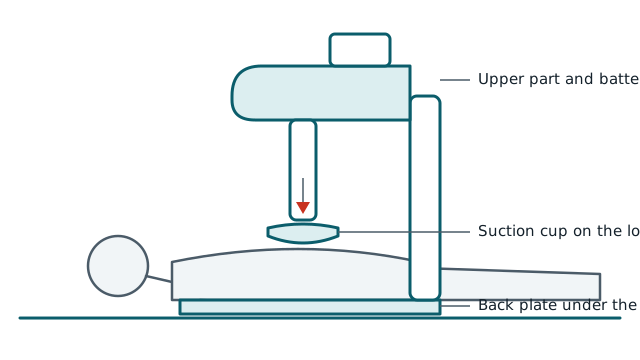
A motor drives a piston up and down. A suction cup on the end of the piston presses the breastbone and helps it spring back. Everything else on the device exists to hold that piston in the right place.
Getting it on the patient
Fitting the device is a two-person job that takes well under a minute once a team has practised. The order matters, because every second without compressions costs blood flow to the brain.[1]
- One rescuer keeps doing manual compressions.
- The other slides the back plate under the patient’s shoulders during a brief pause, then manual compressions resume.
- The upper part, with the legs pulled out, is lowered over the chest and the claws are clicked onto both sides of the back plate.
- The rescuer pushes the suction cup down until it just touches the lower half of the breastbone and presses a button to lock that height as the starting position.
- A press of the start button begins compressions. A strap around the patient’s neck keeps the device from creeping downwards during transport.
The compression cycle
Each cycle has two halves. In the first half the piston drives the breastbone down, squeezing the heart and raising the pressure inside the chest so blood is pushed out to the body. In the second half the piston lifts, the chest expands back to its resting shape, pressure in the chest falls, and blood is drawn back in to refill the heart. Both halves matter. If the chest never fully recoils, the heart never fully refills, and the next compression pumps less.[2]
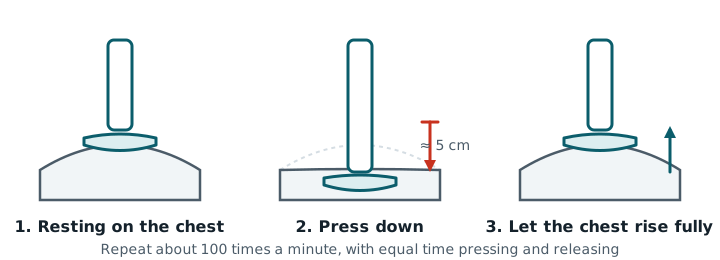
The suction cup is what makes the second half reliable. Because it grips the skin lightly, it helps lift the chest wall back to the exact starting height on every stroke rather than leaving it partly compressed. The first LUCAS model went further and actively pulled the chest upward beyond its resting position; later models are designed to return the chest to neutral and no more.[3]
The numbers
The device is built to match what resuscitation guidelines ask of a human rescuer: push hard, push fast, let the chest come all the way back, and do not stop. The factory settings on the current model are listed below; version 3.1 lets a medical director change the rate and depth within limits.[4]
| Setting | LUCAS 3.1 default | Adjustable range |
|---|---|---|
| Rate | 102 compressions per minute | 102, 111 or 120 per minute |
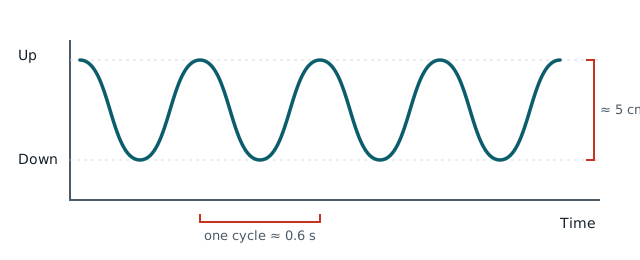
| Depth | 53 mm (about 5 cm) | 45 to 53 mm; 40 to 53 mm for smaller chests |
| Duty cycle | 50 percent | Fixed: equal time pressing and releasing |
| Modes | Continuous, or 30 compressions then a 3-second pause | Pause length and ventilation alerts configurable |
| Patient fit | Breastbone 17 to 30 cm above the back plate; chest up to 45 cm wide; no weight limit | |
| Battery | Lithium-ion polymer, about 45 minutes of compressions; charges in under 2 hours in the device | |
| Weight | 7.8 kg with battery; the battery alone is 0.6 kg | |
Why a machine can be steadier than a person
Studies that measured real-world manual CPR found that even trained professionals often press too slowly, too shallowly, or lean on the chest between compressions, and that quality drops as rescuers tire. In the LINC trial, which used LUCAS 2, the mechanical group spent a larger share of each minute actually being compressed, and compressions were paused less often.[5] None of that turned into more survivors, which is the puzzle the evidence page is about. But consistency is the whole design goal, and it is why the device is still valued in the situations where a human simply cannot keep going.
Working alongside a defibrillator
Defibrillator pads can be placed on the chest either side of the suction cup, and the current models are designed so that a shock can be delivered without stopping the device. The compressions also produce electrical noise on the heart monitor, so most teams pause briefly to read the rhythm, then restart.[5]
What version 3.1 adds
Beyond adjustable rate and depth, the 3.1 firmware records each use and can send a summary report over Wi-Fi or Bluetooth to the manufacturer’s data platform, so a service can review how long the device ran and when it was paused. It also has configurable alerts, for example a reminder to give breaths or a timer for planned pauses.[4]
Keep reading
Sources
- Soar J, Böttiger BW, Carli P, et al. European Resuscitation Council Guidelines 2025: Adult advanced life support. Resuscitation. 2025;215(Suppl 1):110769. doi:10.1016/j.resuscitation.2025.110769
- Kleinman ME, Buick JE, et al. Part 7: Adult basic life support. 2025 American Heart Association Guidelines for Cardiopulmonary Resuscitation and Emergency Cardiovascular Care. Circulation. 2025;152:S448–S478. doi:10.1161/CIR.0000000000001369
- Steen S, Liao Q, Pierre L, Paskevicius A, Sjöberg T. Evaluation of LUCAS, a new device for automatic mechanical compression and active decompression resuscitation. Resuscitation. 2002;55(3):285–299. doi:10.1016/s0300-9572(02)00271-x
- Stryker. LUCAS 3 Chest Compression System, version 3.1: data sheet and Instructions for Use. stryker.com (PDF)
- Rubertsson S, Lindgren E, Smekal D, et al. Mechanical chest compressions and simultaneous defibrillation vs conventional cardiopulmonary resuscitation in out-of-hospital cardiac arrest: the LINC randomized trial. JAMA. 2014;311(1):53–61. doi:10.1001/jama.2013.282538. See also: Mechanical chest compressions improved aspects of CPR in the LINC trial. Resuscitation. 2015. PMID 25766094