
Patients treated with LUCAS survive at about the same rate as patients given good manual CPR. Two large randomised trials, several smaller ones and a Cochrane review all point the same way. That is not the same as saying the device is useless.
The question the trials asked
The hope behind mechanical CPR was simple: if a machine compresses better than tired humans, more patients should leave hospital alive. Laboratory and animal work supported the first half of that sentence. The trials below tested the second half, in the real setting where cardiac arrest usually happens: at home or in the street, with an ambulance crew as the first professional help.
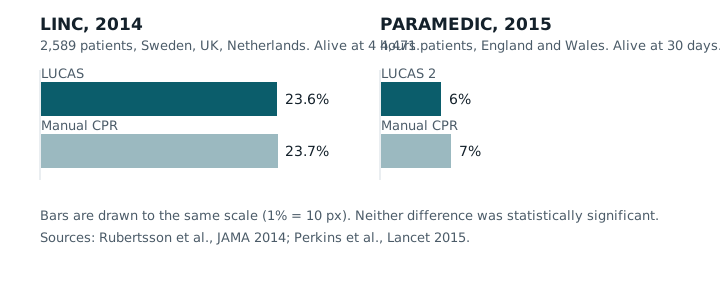
LINC, 2014
LINC stands for LUCAS in Cardiac Arrest. Between 2008 and 2013, ambulance services in Sweden, the Netherlands and England enrolled 2,589 adults with out-of-hospital cardiac arrest. Half were treated with LUCAS 2, using a protocol that allowed shocks during ongoing compressions. The other half received manual CPR following the usual guidelines. The main outcome was survival at four hours.[1]
The result: 23.6 percent survived four hours in the LUCAS group and 23.7 percent in the manual group. Six months later, 8.5 percent of the LUCAS group and 7.6 percent of the manual group were alive with good brain function. That difference is small enough to be chance. Almost all survivors in both groups had good neurological outcomes. The authors concluded that the mechanical strategy did not improve effectiveness compared with manual CPR.[1]
PARAMEDIC, 2015
PARAMEDIC, the Prehospital Randomised Assessment of a Mechanical Compression Device in Cardiac Arrest, was run in four UK ambulance services. Rather than randomising patients, it randomised vehicles: some ambulances carried a LUCAS 2 and some did not, and patients received whichever arrived first. This “pragmatic” design tests what happens when a service simply buys the devices and puts them on the road.[2]
The trial enrolled 4,471 patients between 2010 and 2013. Thirty-day survival was 6 percent in the LUCAS group and 7 percent in the manual group. After adjustment the odds ratio was 0.86, with a confidence interval that comfortably included no effect. Only 60 percent of patients in the LUCAS arm actually received mechanical compressions, which reflects real practice: crews sometimes chose not to fit it. The authors wrote that widespread adoption for routine use does not improve survival.[2]
Putting the trials together
A 2015 meta-analysis pooled the five randomised trials then available, three with LUCAS and two with a different device, the AutoPulse band. Survival to discharge or 30 days was, if anything, slightly lower with mechanical devices, with an average odds ratio of 0.89, though the confidence interval crossed 1. Survival with good neurological outcome pointed the same way.[3]
The 2018 Cochrane review took a broader view, including in-hospital arrests and 11 trials with nearly 13,000 patients. It found no evidence that mechanical devices are superior, and noted that one early trial of the AutoPulse had found reduced survival. Its conclusion is the one most guidelines now echo. Devices used by trained people are a reasonable alternative to manual compressions where good manual compressions are not possible or are dangerous for the rescuer. Examples are a moving ambulance, a long resuscitation, the catheterisation lab, or the minutes before extracorporeal CPR.[4]
A note on the CIRC trial
CIRC is often mentioned in the same breath as LINC and PARAMEDIC, but it tested a different device. The AutoPulse is a band that squeezes the whole chest rather than a piston. With 4,231 analysed patients it found survival to discharge equivalent to high-quality manual CPR, 9.4 percent versus 11.0 percent.[5] It matters here mainly because it reinforces the broader pattern: across device types, mechanical CPR has not beaten manual CPR in large trials.
Where the device may still help
The trials enrolled typical out-of-hospital arrests. They tell us little about the situations where the device was always expected to shine, because those situations are rare or hard to randomise:
- In the catheterisation lab. Opening a blocked coronary artery can take a long time, and a rescuer’s hands would be in the way of the X-ray. Case series report survivors after very long resuscitations with LUCAS running throughout.[6]
- Hypothermia. A very cold patient may need hours of compressions while being rewarmed. No human team can sustain that.
- Bridging to extracorporeal CPR. Centres that connect patients to a heart-lung machine during arrest use mechanical compressions to keep blood flowing until the circuit is running.
- Rescuer safety. Standing unbelted in a moving ambulance, or working with a patient who may be infectious, are risks the device removes.
What the guidelines say
The European Resuscitation Council’s 2025 advanced life support guideline says to consider mechanical chest compressions only if high-quality manual compressions are not practical or would put the rescuers at risk. When a team does use a device, it should be trained on it, so that fitting it interrupts compressions as little as possible.[7]
The American Heart Association’s 2025 guidelines keep the position they took in 2020. They do not recommend routine use of mechanical devices, because trials have not shown a survival benefit. They do allow it in specific circumstances where sustained high-quality manual compressions are impractical, such as prolonged transport, the catheterisation lab, or preparation for extracorporeal CPR.[8][9]
Injuries
Any chest compression, human or mechanical, breaks ribs and bruises organs. The question is whether the device does more damage. PARAMEDIC recorded seven clinical adverse events in the LUCAS group and none in the manual group. The seven were three chest bruises, two chest cuts and two cases of blood in the mouth. Reporting was not blinded, so the comparison is not exact.[2] Autopsy studies from the LINC programme have compared injury patterns between the two groups. They found broadly similar rates of rib and breastbone fractures, with some differences in less common injuries.[10] The Cochrane review judged the injury data too weak to draw firm conclusions either way.[4]
How to read all this
If someone tells you LUCAS saves lives, the honest answer is: not more than good manual CPR does, in the large trials. If someone tells you it is dangerous or pointless, that is not supported either. It is a tool for keeping compressions going when people cannot. Whether a particular ambulance service or hospital should buy one depends on how often they face those situations. It also depends on training well enough that fitting the device does not itself cost precious seconds.
This page summarises published research for general readers. It is not medical advice and does not replace local protocols or the judgement of a treating clinician.
Sources
- Rubertsson S, Lindgren E, Smekal D, et al. Mechanical chest compressions and simultaneous defibrillation vs conventional cardiopulmonary resuscitation in out-of-hospital cardiac arrest: the LINC randomized trial. JAMA. 2014;311(1):53–61. doi:10.1001/jama.2013.282538
- Perkins GD, Lall R, Quinn T, et al. Mechanical versus manual chest compression for out-of-hospital cardiac arrest (PARAMEDIC): a pragmatic, cluster randomised controlled trial. The Lancet. 2015;385(9972):947–955. doi:10.1016/S0140-6736(14)61886-9
- Gates S, Quinn T, Deakin CD, Blair L, Couper K, Perkins GD. Mechanical chest compression for out of hospital cardiac arrest: systematic review and meta-analysis. Resuscitation. 2015;94:91–97. doi:10.1016/j.resuscitation.2015.07.002
- Wang PL, Brooks SC. Mechanical versus manual chest compressions for cardiac arrest. Cochrane Database of Systematic Reviews. 2018;8:CD007260. doi:10.1002/14651858.CD007260.pub4
- Wik L, Olsen JA, Persse D, et al. Manual vs. integrated automatic load-distributing band CPR with equal survival after out of hospital cardiac arrest. The randomized CIRC trial. Resuscitation. 2014;85(6):741–748. doi:10.1016/j.resuscitation.2014.03.005
- Wagner H, et al. Mechanical chest compressions in the coronary catheterization laboratory to facilitate coronary intervention and survival in patients requiring prolonged resuscitation efforts. Scandinavian Journal of Trauma, Resuscitation and Emergency Medicine. 2016;24:4. PMC4721004
- Soar J, Böttiger BW, Carli P, et al. European Resuscitation Council Guidelines 2025: Adult advanced life support. Resuscitation. 2025;215(Suppl 1):110769. doi:10.1016/j.resuscitation.2025.110769
- Kleinman ME, Buick JE, et al. Part 7: Adult basic life support. 2025 American Heart Association Guidelines for Cardiopulmonary Resuscitation and Emergency Cardiovascular Care. Circulation. 2025;152:S448–S478. doi:10.1161/CIR.0000000000001369
- Panchal AR, Bartos JA, Cabañas JG, et al. Part 3: Adult basic and advanced life support. 2020 American Heart Association Guidelines for Cardiopulmonary Resuscitation and Emergency Cardiovascular Care. Circulation. 2020;142(16 Suppl 2):S366–S468. doi:10.1161/CIR.0000000000000916
- Smekal D, Johansson J, Huzevka T, Rubertsson S. No difference in autopsy detected injuries in cardiac arrest patients treated with manual chest compressions compared with mechanical compressions with the LUCAS device: a pilot study. Resuscitation. 2009;80(10):1104–1107. sciencedirect.com. See also: Injuries associated with mechanical chest compressions and active decompressions after out-of-hospital cardiac arrest: a subgroup analysis of non-survivors from a randomized study. PMC9926013